
European Nights
What Anfield under floodlights does to grown adults. Written by a believer, seven time zones away.
There is a specific category of football match that the sport files under the plain label European nights, and everyone who follows Liverpool knows the file is not plain at all. It means a midweek evening, a continental opponent, floodlights instead of daylight, and a stadium in the north of England behaving less like a venue than like weather. The house supports this club from seven time zones away, which means European nights happen here at two and three in the morning, and we keep attending them anyway, in living rooms and warung kopi, for reasons this piece will try to make respectable.
Start with the sound, because Anfield's argument begins before kickoff. You'll Never Walk Alone was a show tune from Carousel until Gerry and the Pacemakers, a Liverpool band, took it to number one in 1963 and the Kop, the steep terrace behind the goal, adopted it as liturgy. Sixty years later, twenty-odd thousand people sing it with scarves raised, slightly slow, slightly flat, and entirely devastating. Opposing players have said in interviews that they made errors in the opening minutes because of it. That is not romance talking; that is professional athletes reporting an acoustic phenomenon with competitive consequences.
Then the genre itself: the comeback. The club's supporters have watched enough improbable reversals that they have stopped being improbable and become a house style. Istanbul 2005 is the canonical text, three goals down at half time in a Champions League final against a great Milan side, level within fifteen second-half minutes, winning on penalties. Barcelona 2019 is the domestic miracle, 3-0 down from the first leg, missing two forwards, winning 4-0 with a corner taken quickly by a ballboy's alertness and Divock Origi's finish while Barcelona's defense was still composing itself. A club that has done this repeatedly acquires something almost unfair: opponents defending a lead at Anfield are defending against their own knowledge of history.
What interests the house, beyond the partisanship it happily admits, is the mechanics of collective belief. A comeback requires a stadium to keep producing energy after logic has withdrawn its support, and the energy is real: players sprint further in its presence, referees are human within it, the opposing keeper feels every one of the forty thousand exhalations behind his goal. The Kop does not watch the match. It participates in it, the way a gospel congregation participates in a sermon, and the away teams that survive it earn a specific respect reserved for people who have sung in someone else's church.
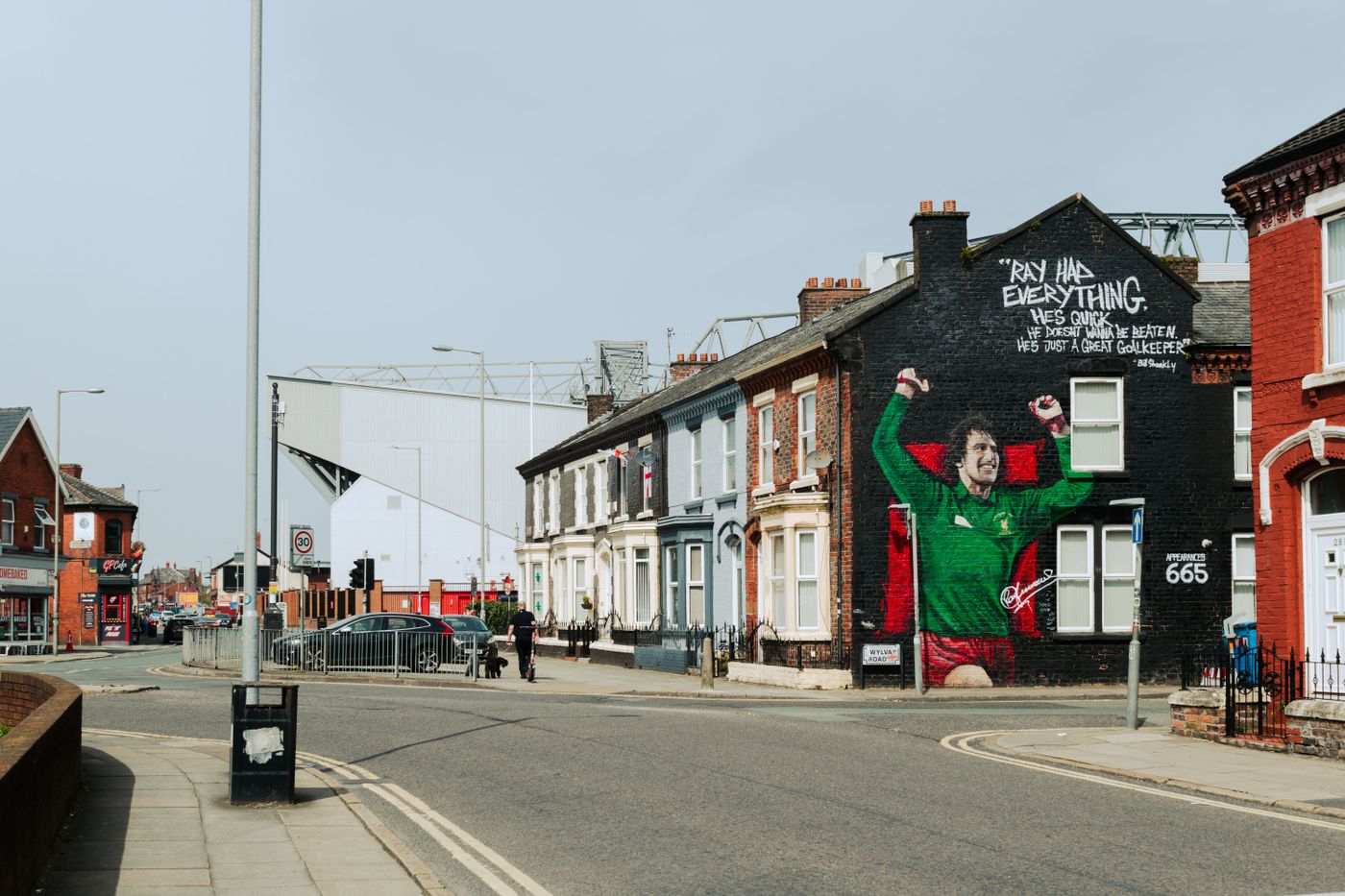
The inheritance has an author. Bill Shankly arrived in 1959 to a second-division club with a training ground the players called a wilderness, and built, in his phrase, a bastion of invincibility. His line about football being much more serious than life and death gets quoted as a joke; said in his accent, with his politics, it was a claim about dignity, that a dock city's working people deserved one arena where they were unbeatable. The mural of him near the ground quotes his simpler creed: he made the people happy. Everything the modern club sells, and it sells plenty, is licensed against the credibility that man banked.
And what does any of this have to do with a perfume journal? Everything, actually. This section exists for the body's own tastes, and supporting a club is a bodily practice: the cortisol of a defended corner, the leap when the net moves, the specific exhaustion of a 3 a.m. final defeat carried into a work morning. It is also the purest case study in memory the house knows. Ask any Liverpool supporter where they were for Istanbul and you will get weather, furniture, who was beside them, what the room smelled like. Nights like that are bottled whether anyone intends it or not. We simply take the intention seriously.
The house keeps its nobar piece for the communal version, a hundred strangers and one screen. European nights are the concentrated dose: one club, one ground, one song promising the only thing supporters actually require, which is not victory. Walk on, with hope in your heart. The trophies are incidental. The walking together is the product.