
Nasi Padang, at Speed
Twelve plates before you finish sitting down, and you pay only for what you touch.
There is a service ritual on this archipelago that outclasses every tasting menu the house has ever been seated for, and it costs less than the tasting menu's parking. You enter a rumah makan Padang, you sit, and before your chair has fully accepted your weight, a waiter arrives with a tower of small plates balanced up one arm, a feat of load engineering that should be studied by universities, and deals them across your table like cards. Rendang, gulai ayam, dendeng balado, cassava leaf, eggs in chili, fried things whose names vary by province. Ten, twelve, sometimes sixteen plates. Nothing was ordered. Everything is available. The meal has begun before you finished arriving.
Then the mechanism reveals its genius: you pay only for what you touch. The untouched plates return to the front, intact and unbilled, and the bill is composed afterward by a man who looks at the wreckage of your table for three seconds and prices it precisely. The Minangkabau, the West Sumatran culture that built this system and exported it to every street corner in the nation, invented something the technology industry would later name, with great ceremony, the freemium model, the free trial, and inventory as display. They did it with curry, generations earlier, at a speed no app has matched.
Consider what the system requires to function, because this is the Table section and the house reads meals as institutions. It requires trust running in both directions: the restaurant trusts you not to fondle every plate, and you trust the reader of the wreckage to bill you honestly. It requires a kitchen that cooks everything in advance and holds it at flavor, which is why Padang cooking is built on dishes that improve as they sit, rendang above all, essentially a preservation technology wearing a masterpiece costume. And it requires a service culture where speed is a form of respect rather than a symptom of rush. The customer's time is honored; the food's time was spent long before, in the slow hours the rendang demanded.
That inversion deserves a pause: this is fast service of slow food, the exact opposite of the fast food the world settled for. A proper rendang is hours of patient reduction, coconut milk taken all the way down past caramel into something dark, dry and permanent, spice laid into meat the way memory is laid into a childhood. Our sambal essay called chili a memory technology; rendang is the archive format, dense, portable, effectively immortal. The Minangkabau were a traveling merchant culture, and their signature dish is, not coincidentally, the best travel food ever engineered.
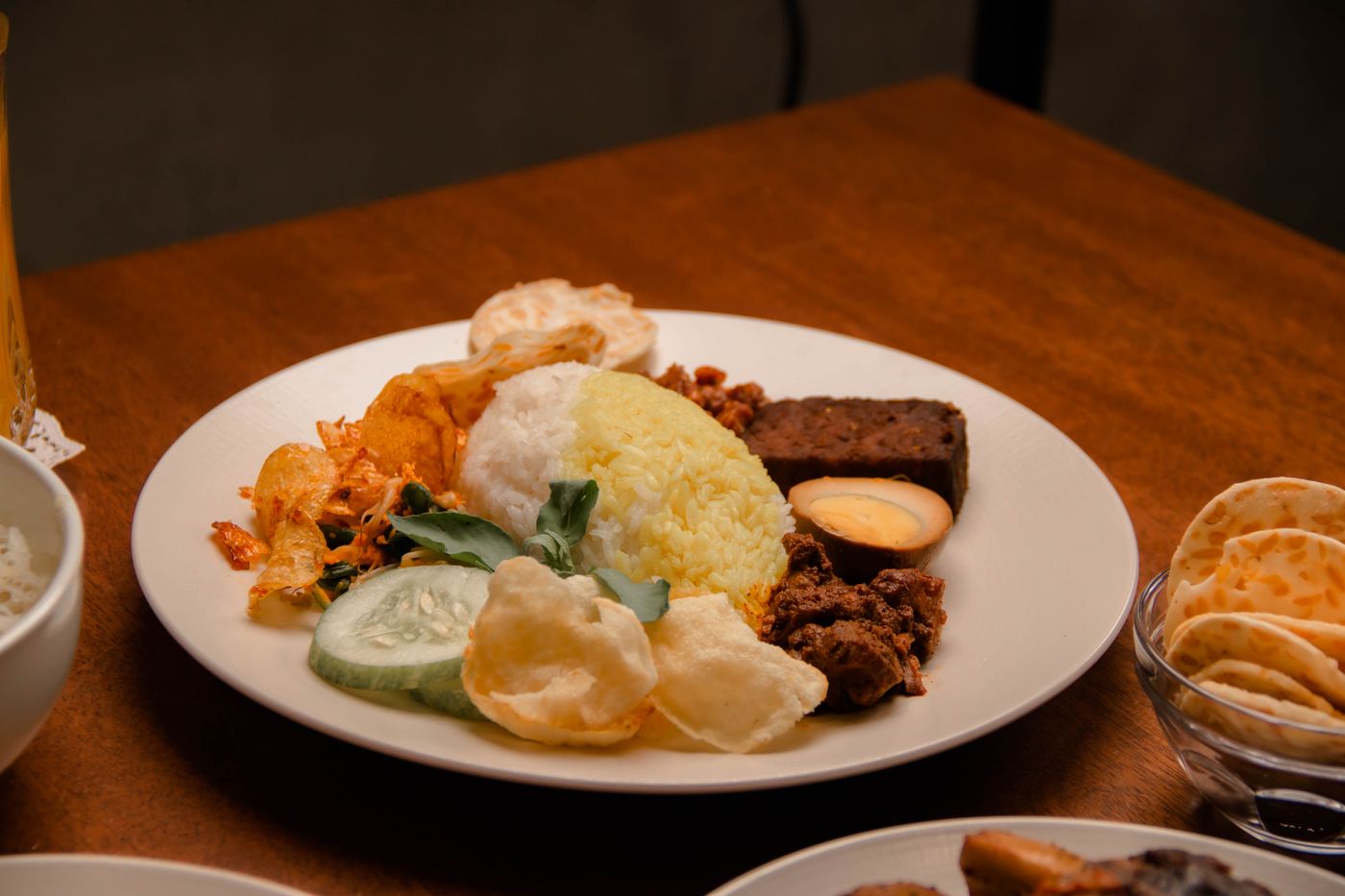
The house calls the plate tower interface design and means it technically. A menu is a description of food; the Padang spread is the food, presented as its own catalogue, browsable by eye and nose, zero reading required, zero wrong orders possible. Every plate is simultaneously inventory, advertisement and portion. The information design profession spends careers chasing this kind of directness and rarely lands it. Show, charge for use, settle by inspection, repeat: the whole stack, executed by a man with twelve plates on his forearm who has never once dropped the gulai.
And because every Table essay ends at the bench eventually: the Padang spread is how the house thinks about a fragrance wardrobe. Not one bottle ordered from a menu, but a spread laid out, met by mood, paid for in attention only where attention lands. Some days you touch the rendang, some days only the cassava leaf and sambal. Nothing untouched is wasted; it returns to the front, ready for the next hunger. The Wardrobe page is, in retrospect, a rumah makan Padang for the shelf.
Practice, and bring appetite: go at noon, when the turnover guarantees freshness. Let them deal the full spread, and hold the ritual: eat with the right hand if you can, kuah over the rice, and do not rush the man reading your table afterward; he is performing the fastest honest accounting in commerce. Then notice, walking out, that the whole transaction, ninety seconds of theater, hours of cooking, generations of trust, cost less than a city coffee. Some countries keep their genius in museums. This one keeps it warm, behind glass, stacked up one arm.