
Sambal Is a Memory Technology
A thousand regional versions, ground on stone, and the dish most likely to make an islander abroad cry.
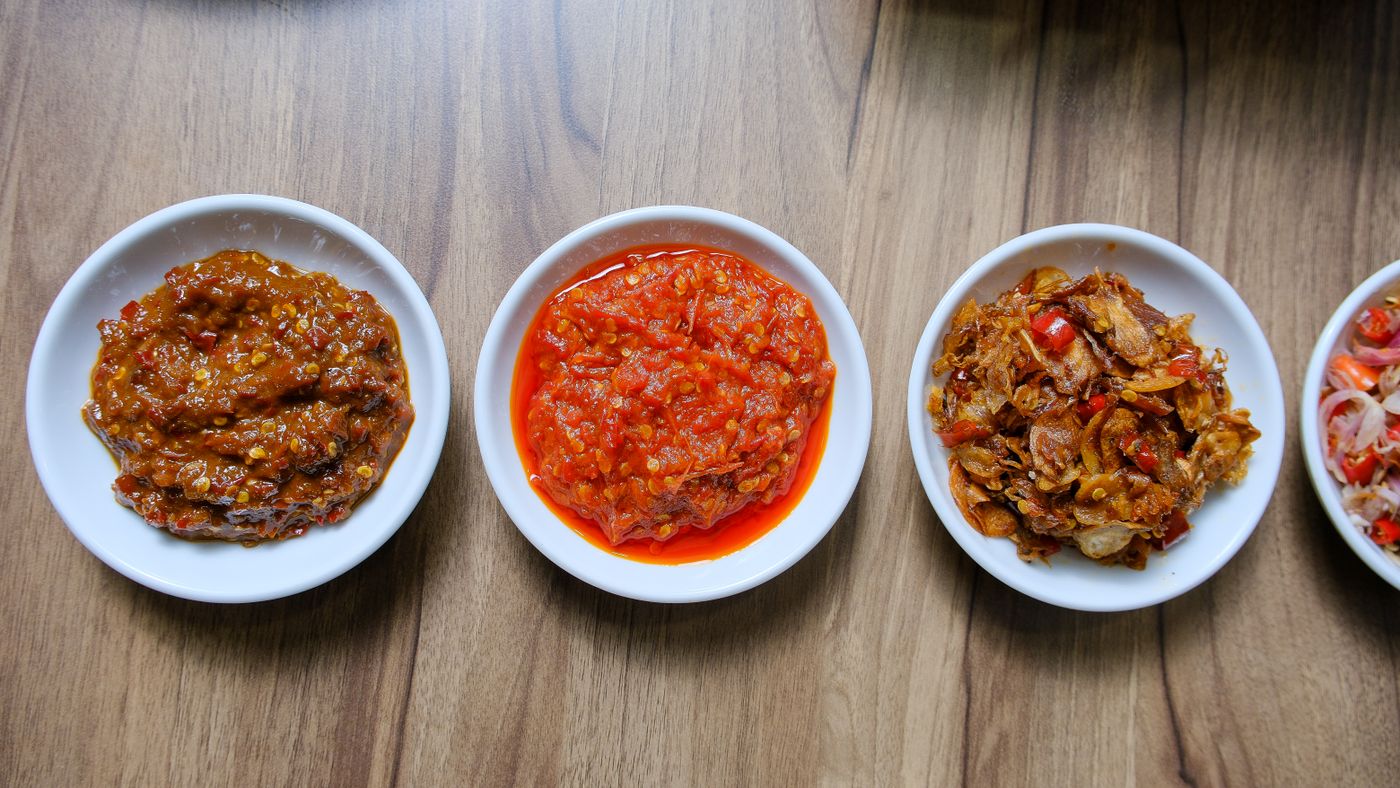
Ask an Indonesian living overseas what they miss and the answer is rarely the monument or the beach. It is a paste of chilies, ground on a stone cobek, in one specific kitchen, by one specific pair of hands. Sambal is the national condiment, but that undersells it. There are hundreds of documented versions, terasi and matah, dabu-dabu and ijo, roa and bajak, and beneath the official list, millions of unwritten ones, because every household grinds its own and every one of them is slightly, defiantly different.
That difference is the point. A sambal is a fingerprint. The ratio of chili to shallot, the decision between raw and fried, lime or tamarind, the coarseness of the grind, whether the sugar goes in at all: each choice was made by somebody's grandmother and defended for generations. You can read a family's island, budget and temperament in a spoonful. Industrial sambal in a jar is not wrong, exactly. It is just anonymous, a fingerprint wiped clean.
This is why we call it a memory technology, and we mean the term precisely. The scent of a specific sambal hitting hot oil can retrieve a childhood kitchen faster and more completely than any photograph, because smell and taste are wired directly into the brain's memory storage without asking permission first. The house built its entire practice on this mechanism. A perfume and a sambal are the same machine: volatile molecules, arranged by a specific hand, that carry a specific place and person forward in time.
The technology has one weakness: it is stored in people, not files. A sambal survives exactly as long as somebody keeps grinding it, and the moment a family switches permanently to the jar, one version of one island's memory goes quiet. The fix costs nothing. Stand in the kitchen. Watch the hand. Learn the ratio by eye the way it has always been learned, the way the Gayo farmers learned their trees. Then grind it for someone younger.
And if you are far from home tonight: find the chilies, borrow a mortar, and make the version you grew up on, badly. The first taste will be wrong in a way that tells you exactly what right was. That, too, is the technology working.