
The Airport You Want to Arrive At
An airport is a country's opening sentence, delivered to every visitor before a single word is exchanged. Most nations write a bad one, at enormous expense, and never find out why.
In 1992 the French anthropologist Marc Augé gave us the phrase that has haunted airport design ever since. He called them non-places: spaces defined by transit rather than dwelling, carrying no history, producing no relationships, offering no identity to the people passing through. Airports, motorways, supermarkets, hotel chains. Environments where you are a passenger rather than a person, processed rather than received. It was a diagnosis, not an insult, and it was accurate about almost every terminal built in the four decades that followed.
What makes the phrase so useful is that it identifies exactly what the good airports are refusing. Because there are good ones, and their goodness is not accidental, not expensive in the way people assume, and almost entirely absent from the marketing that airports produce about themselves.
Start with the one everyone cites. Changi has topped international rankings for most of the last two decades, and the reason is not the butterfly garden or the swimming pool or even Jewel, the 2019 addition with an indoor waterfall dropping through the middle of a shopping complex. Those are the photographs. The actual achievement is duller and much harder: the distance from your aircraft seat to a taxi is short, the immigration queue moves, the signage never leaves you guessing, and the whole sequence works at three in the morning when you are exhausted and stupid. Singapore treated its airport as national infrastructure with strategic value rather than as a cost centre, and staffed it accordingly.
Helsinki understood a different version of the same idea. Vantaa is not spectacular and does not try to be. It is calm, legible, full of daylight and Finnish furniture you are permitted to sleep on, and its genuine competitive advantage is the transfer time. A small country positioned itself as the efficient hinge between Europe and Asia and then designed a building that keeps the promise. That is a national strategy expressed as a floor plan.
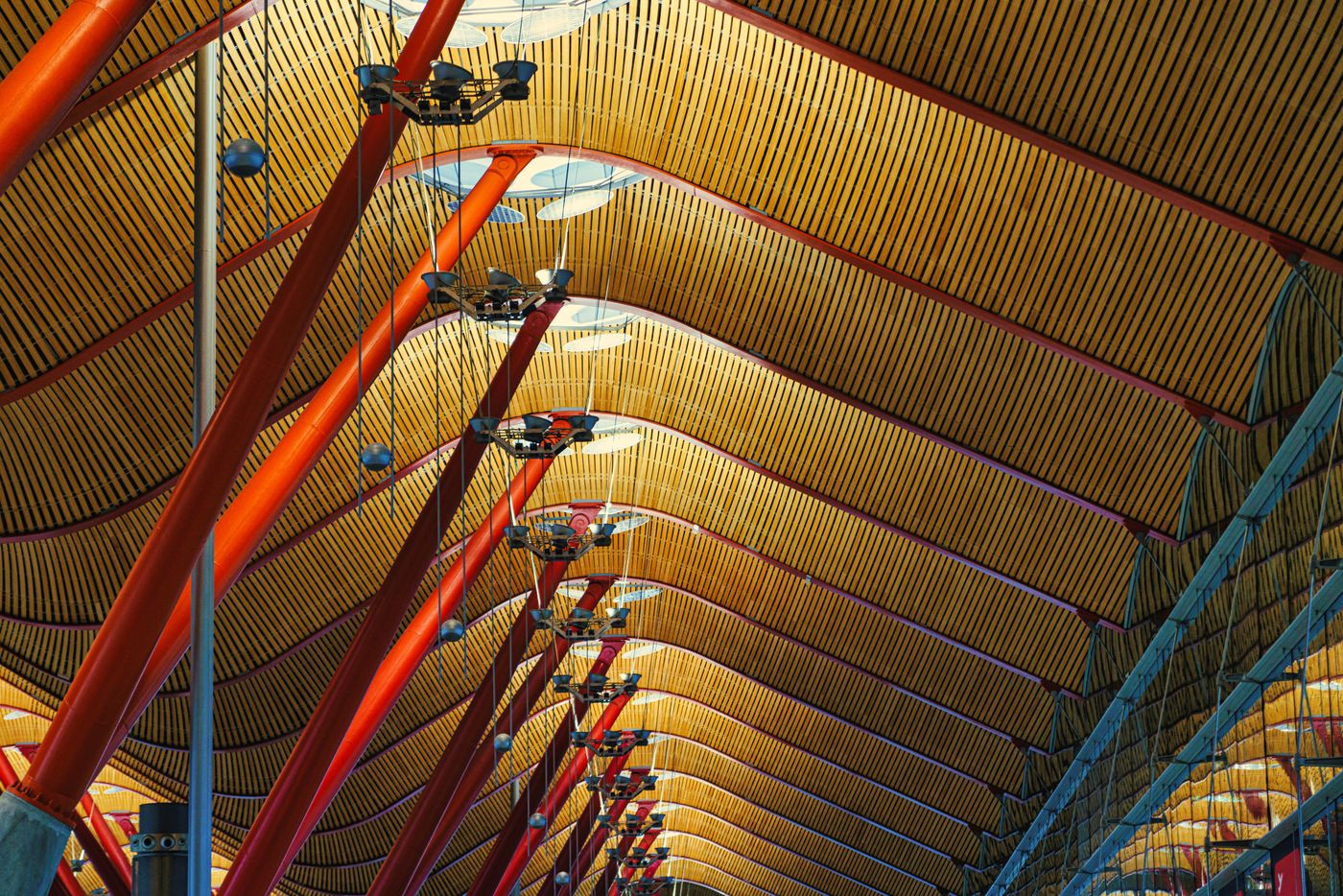
Then there are the architectural arguments. Kansai, opened in 1994, sits on an artificial island in Osaka Bay because there was nowhere else to put it, and Renzo Piano gave it a roof shaped by airflow rather than by styling. It has also been sinking faster than the engineers projected, which is either a cautionary tale or a reminder that ambitious things carry real risk. Madrid Barajas T4, by Richard Rogers with Estudio Lamela, won the Stirling Prize in 2006 for a bamboo ceiling that undulates over colour graded columns, and the colour is not decoration: it tells you where you are in a building otherwise long enough to lose a person in.
Before any of them, in 1962, Eero Saarinen finished the TWA Flight Center at what is now JFK, and it remains the high water mark for a proposition the industry has largely abandoned: that flying might feel like an occasion. The building is a bird, more or less, and everything in it curves. It was obsolete within a decade because jets got bigger and security got serious, and it is now a hotel, which is either a tragedy or an appropriate retirement.
What all the good ones share turns out to be a short and unglamorous list. Daylight, because a windowless terminal makes a tired body feel worse in a way no lighting scheme has ever solved. Sightlines, so you can see the next decision before you reach it. Short walks, because distance is the tax nobody accounts for. Enough staff at immigration, since a beautiful hall containing a ninety minute queue is simply a beautiful room in which to be angry. And restraint with noise: several airports have deliberately reduced or eliminated general announcements, having worked out that a constant PA is not information but stress.
Notice that only two of those cost serious money, and neither of them is the waterfall. Most of what separates a humane airport from a hostile one is decided in planning, not in finishes, and is therefore invisible in the renderings that get a project approved. This is why so many expensive terminals feel worse than modest ones: the budget went to the ceiling when the problem was the walk.
There is a behavioural footnote here that has become famous, possibly beyond its evidence. At Schiphol, small etched flies were placed in the urinals on the theory that men aim at things, and the airport reported a substantial reduction in spillage and cleaning costs. Whether the precise figures hold up, the principle is the correct one and it is the opposite of a grand gesture: find the small friction, solve it cheaply, tell nobody. An airport is a machine made of ten thousand such details, and the ones that feel effortless have simply been through more iterations of that question.
Arrival and departure are also not the same problem, and treating them as one building is the original error. Departure is anticipation, and it tolerates shops, because a person with ninety spare minutes will spend them. Arrival is the opposite: the traveller wants the exit and nothing else, and every metre of retail placed between an exhausted body and a taxi is an insult dressed as an amenity. The airports people love are almost always the ones that understood arrivals should be fast and departures should be pleasant, rather than optimising both for the same commercial yield.
For this house there is one more layer, and it is the reason airports belong in a fragrance journal at all. The first breath of a country arrives in the gap at the end of the jetbridge, in those two or three seconds where the aircraft's sealed air gives way to whatever is outside. Every country has a smell there and it is unmistakable. Humidity and clove and rain on hot concrete in Jakarta. Cold mineral air and cleaning product in Northern Europe. Dust and jet fuel and something faintly sweet in the Gulf. You have not seen anything yet, read anything, or spoken to anyone. You already know where you are.
That is the real opening sentence, and no design committee controls it. What they control is what happens in the ninety minutes after: whether the building respects a tired person, whether the queue moves, whether anyone thought about the walk. Countries spend fortunes on tourism campaigns to shape an impression that has usually been settled before the visitor reaches the car park.
Soekarno-Hatta's Terminal 3 gets more right than the international commentary allows, and still loses much of the advantage on the ground journey that follows. Which is the last thing worth saying about airports: they do not end at the door. The arrival sequence includes the road, the queue for the car, the first twenty minutes of traffic. A country that builds a fine terminal and then abandons the visitor at the kerb has written an excellent first sentence and no second one.