
Melaka, the Old Trade Wind
For a century, nearly every scented material on earth changed hands in one straits port. Walking Melaka as a perfumer's pilgrimage.
There is a sentence from the Portuguese apothecary Tome Pires, written around 1515, that every perfumer should be made to memorize: whoever is lord of Malacca, he wrote, has his hand on the throat of Venice. He meant that the little port on the Malay straits controlled the flow of spices and aromatics to the entire world, and that Venice's perfumed wealth, and Europe's, was decided in a harbor most Europeans could not place on a map. For roughly a century, the fifteenth into the sixteenth, Melaka was the exchange floor of scent itself: cloves and nutmeg from Maluku, camphor from Borneo, sandalwood from Timor, gaharu, our agarwood, from the forests of Sumatra and beyond, benzoin from the Batak highlands, pepper from everywhere, changing hands between Javanese, Gujarati, Chinese, Arab, and Tamil merchants in a city said to trade in eighty languages.
The mechanism was the wind, and the wind explains the city. The Asian monsoons blow reliably one direction half the year and reverse for the other half; ships from China rode the northeast monsoon down, ships from India rode the southwest monsoon in, and the straits of Melaka were where the two systems met and, crucially, waited. Merchants were stranded together, sometimes for months, until their wind came back. Warehouses, credit, marriage, cuisine, and creole languages all condensed out of that waiting. The scheduled patience of the planet built the port; Melaka is what happens when weather forces strangers to become neighbors twice a year.
Walk the old town today and the layers sit on each other like sediment. The Portuguese took the city in 1511 and left a ruined gate and a hilltop church where Francis Xavier was briefly buried. The Dutch took it in 1641 and left the red Stadthuys square and brick warehouses with Amsterdam's proportions sweating in equatorial heat. The British swapped into it in 1824 with the treaty that also drew the line making Sumatra Dutch, the same line that decided this house would one day be Indonesian rather than Malaysian, a border drawn through a family of ports that had always faced each other. And through all of it runs Jonker Street and its Peranakan shophouses, the merchant culture, Chinese-Malay and gloriously both, that outlasted every European flag planted over it.
The nose does not need the museum plaques. Morning on Harmony Street, so called because mosque, Chinese temple, and Hindu temple share three hundred meters, is a working archive of the old cargo: sandalwood and joss smoke from Cheng Hoon Teng, oud-heavy attars near Kampung Kling mosque, jasmine garlands at the Chitty temple, and under it all the salt-mud breath of the river that carried everything. The kitchens hold the other half of the inventory. Peranakan cooking is the spice trade domesticated: nutmeg, clove, galangal, candlenut, and belacan folded into laksa and ayam buah keluak, recipes that read like a warehouse manifest circa 1500. The sambal essay's thesis applies with compound interest here: this food is the trade wind, eaten.
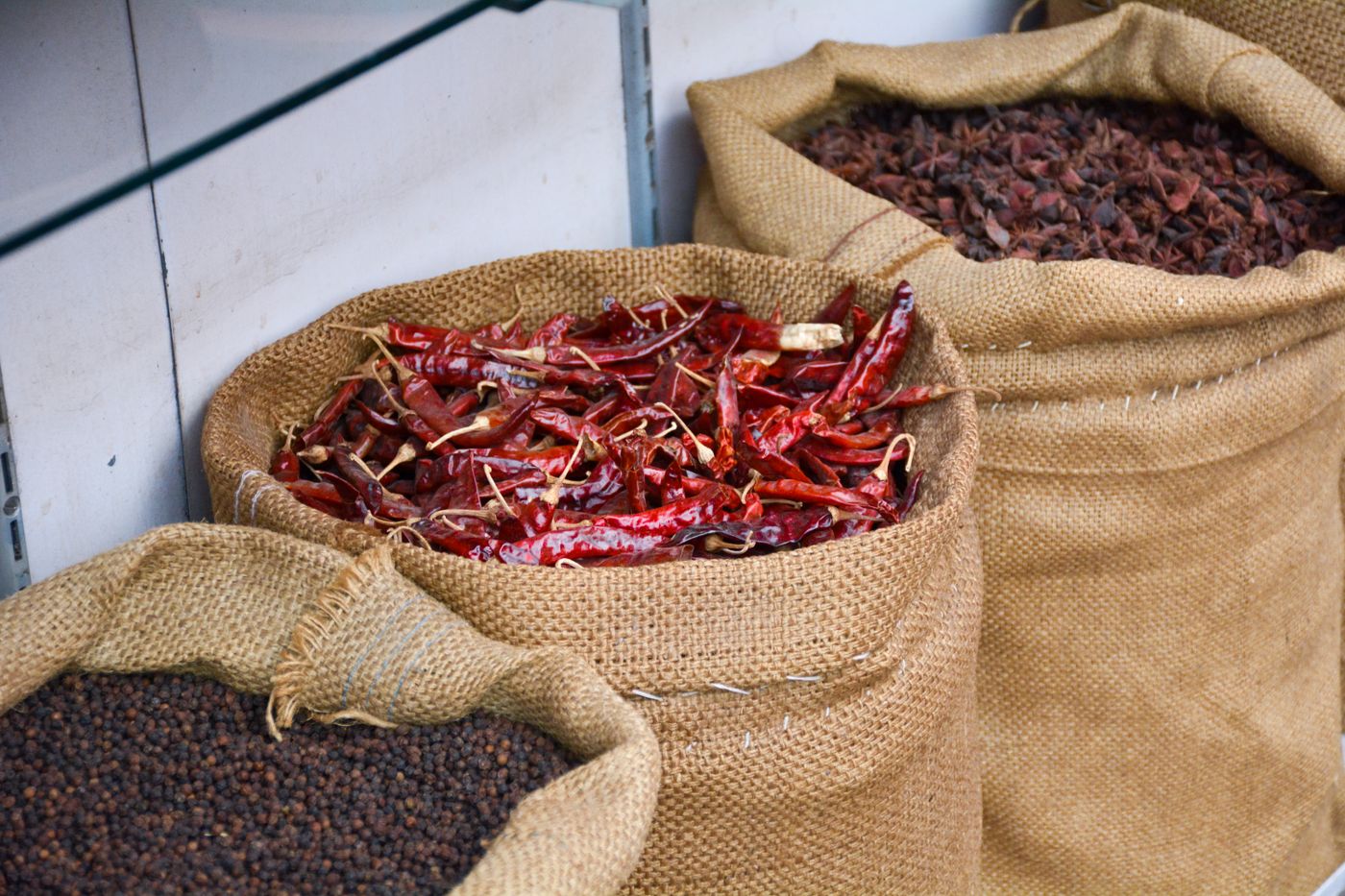
For this house, the pilgrimage is professional. Nearly every material in the Indonesian perfumer's inheritance moved through that harbor: the patchouli and benzoin of Sumatra, the sandalwood of the eastern islands, the gaharu that remains Southeast Asia's most precious smoke. When the house buys those materials today, the invoices trace supply chains that are, in several cases, the same routes with engines added; readers of the Ricardo essay will recognize Melaka as that theorem's grandest historical demonstration, comparative advantage with a harbor. Standing on the river bridge at dusk, a perfumer is looking at the old trading floor of everything on the bench.
Honesty about the present: Melaka's old town survived, was UNESCO-listed in 2008 alongside Penang's George Town, and now performs itself on weekends, when Jonker Street becomes a night market of trishaws dressed as cartoon characters playing pop at volumes the Dutch never imagined. The house's advice is the same medicine prescribed in the Kyoto essay: come on a weekday, wake early, and the town reverts to itself, kopitiam shutters opening, incense being lit, the river slack and quiet. Heritage towns keep two clocks. Visit on the older one.
The travelogue's smuggled lesson home: every taste this journal covers arrived on a wind. The coffee in the Gayo essay, the cloves in the kretek smoke of a Jakarta evening, the sandalwood in half this house's formulas, all of it once waited in a Melaka warehouse for the weather to turn. Modernity abolished the waiting but kept the routes, and a perfume house on this archipelago is, whether it likes it or not, a downstream tenant of that harbor. The house likes it. Some inheritances are worth claiming on purpose.