
Acetate, Cut Slow
Glasses sit on your face for sixteen hours a day. Sabae decided that deserved craftsmanship, and built a town on the decision.
Consider, for one honest minute, the intimacy budget of your possessions. Your watch touches a wrist. Your shoes get eight hours and a desk between them and anyone's attention. Your glasses sit at the exact center of your face, in every conversation, every photograph, every mirror, for most of your waking life. They are the frame through which other people literally see you seeing them. And yet the world buys them the way it buys phone cases, which is one of the stranger mispricings in the whole economy of objects.
The town that refused the mispricing is Sabae, in Fukui prefecture on Japan's west coast, snow country. In 1905 a local official named Gozaemon Masunaga started teaching farmers to make spectacles as winter work, on the theory that eyewear would one day matter and that idle winters were a waste of good hands. A century later Sabae produces the large majority of Japan's frames and stands with Italy's Cadore region as one of the two serious eyewear capitals on earth. The town's specialty runs from titanium, it pioneered the use of titanium in frames when everyone said the metal could not be worked that small, to the material this piece loves most: cellulose acetate, cut slow.
The difference is worth understanding, because it is invisible at arm's length and unmistakable on the face. Cheap frames are injection-molded: liquid plastic shot into a mold, light, hollow-feeling, colored on the surface. Proper acetate begins as a block, a laminate of cotton and wood pulp in which the color runs all the way through, layered like terrazzo or tortoiseshell by hand before curing. The blocks are sliced, milled, and then, this is the step that separates the serious houses, tumbled for days or weeks in rotating barrels of wood chips, bamboo, and polishing compound, until every surface acquires a gloss no buffing wheel can fake. The famous makers tumble longest. A Jacques Marie Mage or a great Sabae frame has spent more time being gently beaten by wood chips than most garments spend being made at all.
Then there is the hardware, the part of the trade that rewards a Lange-trained eye. Real frames use pinned hinges, riveted through the acetate, serviceable in fifty years. Corewires are laid inside the temples so the arms can be adjusted by a human with a hot-air blower rather than snapped. The best makers finish the inner surfaces, the side that faces your temples, as carefully as the show side, which readers of our Lange essay will recognize as the house's favorite moral test passed in a second material.
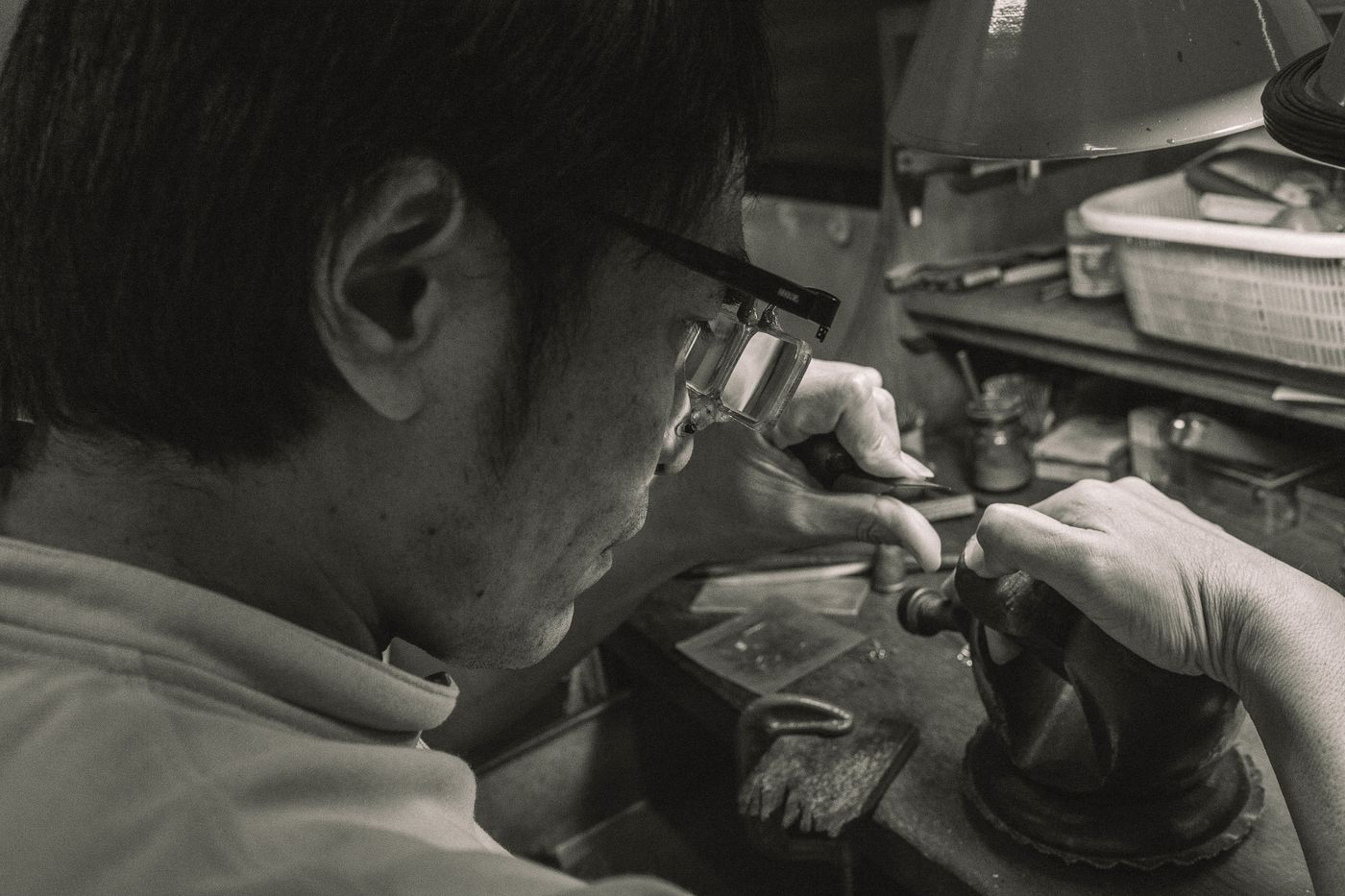
The aging is the argument's closing move. Injection plastic dulls, whitens at the stress points, and dies. Block acetate develops what furniture people call patina: micro-polish from skin and cloth, a deepening of the color where the light hits, temple arms that have quietly reshaped themselves to the specific skull they serve. A decade-old pair of good frames fits its owner the way a broken-in jacket does, and this is why the vintage market for serious eyewear keeps climbing while fast frames are landfill within two years. The economics readers can do the arithmetic: one 4-million-rupiah frame worn for ten years against five 800-thousand frames worn briefly and hated quietly is not even a close contest, and the expensive option was also the frugal one.
How to buy, since this section owes its readers practicality. Weight is the first tell: block acetate has density, a quiet heft. Look at the hinge, pins and rivets, not a molded seam. Look for the corewire in the temple. Ask where the frame was made, and if the answer is Sabae, Fukui, or the Italian houses that still cut from block, you are in serious territory. Then ignore the logo entirely and judge the face in the mirror after a slow count of ten, because eyewear is the one purchase where the object and your identity are the same purchase.
The house thinks about Sabae more than a perfume operation strictly needs to, because the parallel is complete: a small place, far from the capitals, that decided the object everyone underestimates deserved a century of accumulated seriousness, and then out-crafted the famous cities at their own trade. If that story sounds familiar, it is the one this house is attempting from Jakarta, one bottle at a time.