
Kemenyan, and the Smoke That Raised Us
A resin bled from Sumatran bark, burned in Indonesian houses for a thousand years, sold to Europe under a mangled Arabic name, and sitting on this bench today. The hundredth essay is about the smell we already knew.
Somebody in your family burned it. That is the safest assumption anyone can make about an Indonesian reader and a piece of kemenyan. At a grave, at a wedding, on a Thursday evening for no stated reason, in a room where a prayer was about to be said, in a house that smelled of it so consistently that you never thought of it as a smell at all. It was simply what the air was made of after dark.
The material is benzoin, a resin that bleeds from trees of the genus Styrax when the bark is cut. The Sumatran variety comes principally from the highlands of North Sumatra, in the Toba and Tapanuli country, where Batak families have kept kemenyan gardens for generations. The word for those groves, tombak haminjon, describes something between a forest and an inheritance. A tree is tapped by incising the trunk, the wound weeps, the resin hardens over weeks into pale tears, and a collector returns to lift them off by hand. A productive tree can be worked for decades. The knowledge of when and how deep to cut is not written down anywhere.
It has been traded for a very long time, and the European name it eventually acquired preserves the route. Arab merchants called it luban jawi, meaning roughly the frankincense of Java, the Javanese incense. Carried west, that phrase was worn down by Romance tongues into banjawi, then benjoin, and finally arrived in English as benzoin, the initial syllable having been lost somewhere in the Mediterranean when a speaker mistook it for a definite article. The word sitting in every perfumer's formula today is a corrupted Arabic description of an Indonesian product, its origin still legible if you look at it for a second.
What it smells like, burned, is not what it smells like on a blotter. Set alight, kemenyan produces a smoke that is sweet, resinous, faintly medicinal, with something almost like vanilla underneath and a bitter edge on top. It is heavier than church incense and less austere than sandalwood. It fills a room from the floor up and it stays in fabric for days, which is why the smell attaches so ferociously to a house, and why people who moved away can be undone by encountering it thirty years later in a country where nobody knows what it is.
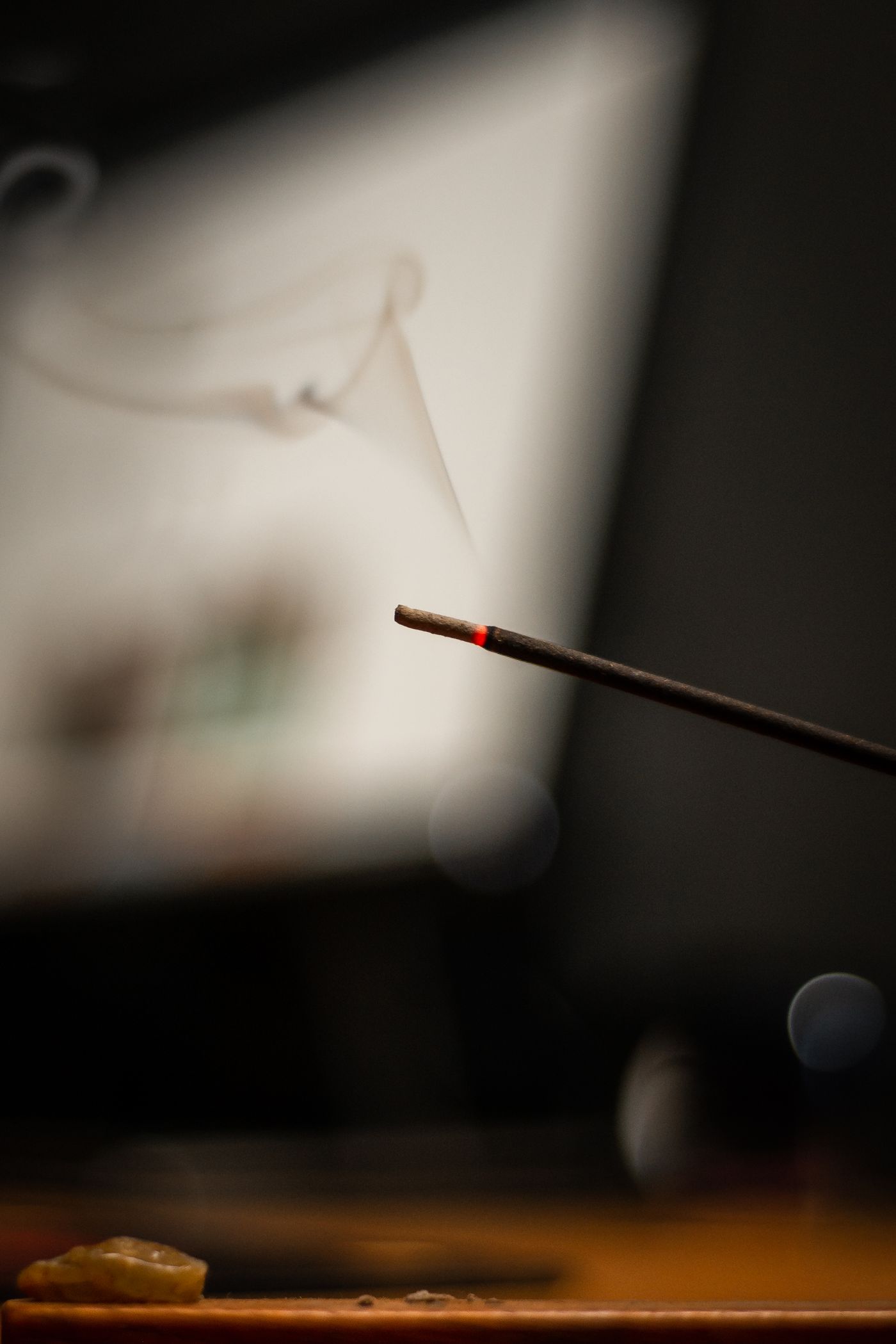
On a perfumer's bench it arrives processed, as resinoid or absolute, and behaves differently. It is warm, balsamic, sweet, with cinnamic facets, and it is one of the great fixatives. It slows the evaporation of everything around it, holds a composition together at the base, and lends the particular ambery weight that the whole oriental family depends on. A great many fragrances people describe as warm are warm because of benzoin, and almost nobody wearing them could name it.
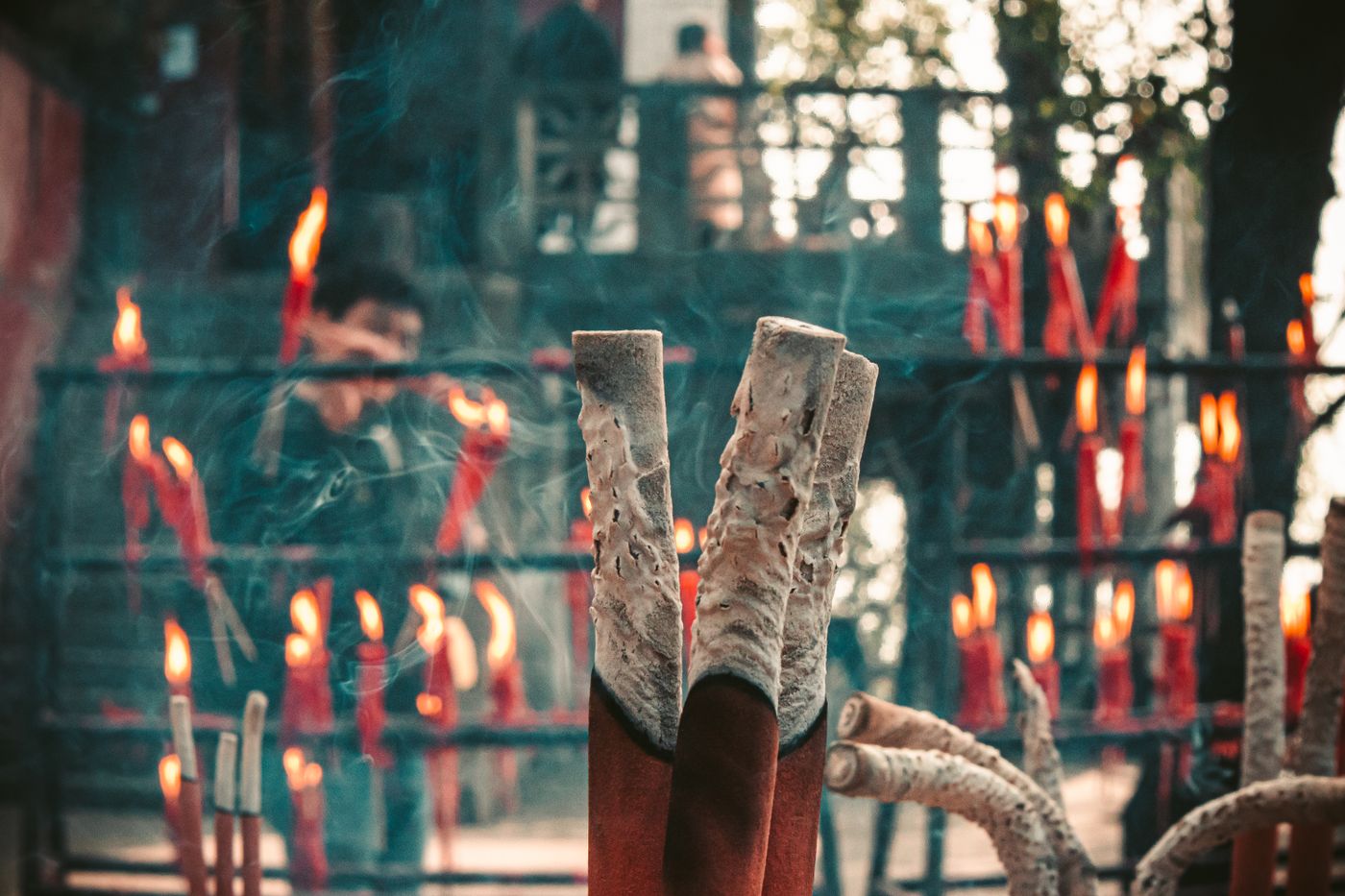
It has done the same work elsewhere for centuries. It is in the compound tincture used in traditional medicine as friar's balsam, inhaled over hot water for a cough by people who have never heard of Sumatra. It has been burned in Catholic and Orthodox churches, in Buddhist temples, in Javanese ritual, in Batak ceremony, at Malay weddings. Very few materials have been simultaneously sacred in that many unrelated traditions, and the reason is chemistry rather than theology: it smells like ceremony to almost everyone, regardless of what they believe.
Now the uncomfortable part, which any Indonesian house working with this material has an obligation to state plainly. The farmer who cuts the tree and collects the tears occupies the worst position in the value chain by a very large margin. The resin is bought at the farm gate for a fraction of what it will command once it has been sorted, graded, shipped, processed into resinoid in Europe, and sold onward to perfumery. Along that route the price multiplies many times over, and almost none of the multiplication returns to Tapanuli.
The consequences are visible on the ground. Kemenyan gardens have been steadily converted to faster returning crops, particularly pulpwood and eucalyptus, because a family cannot raise children on a price that has barely moved in real terms while everything else has. Young people leave for the cities. The specific knowledge, which trees, which season, how deep, is held increasingly by older people with nobody asking them. A material that has been harvested continuously for something like a thousand years is being abandoned within a couple of generations, not because the world stopped wanting it, but because the people producing it were paid too little to continue.
This journal has argued elsewhere that a country builds attraction by exporting finished objects rather than raw ingredients, and kemenyan is the sharpest illustration of it available. Indonesia supplies a majority of the world's benzoin and is essentially invisible in the story told about the fragrances that contain it. The resin leaves as material and returns as French luxury. The name on the bottle is never Batak. That is not a conspiracy, it is simply what happens when a country sells the beginning of a chain and never the end of it.
Which is the whole argument for making things here, and the reason this house exists in the form it does. Not sentiment about heritage. A structural observation: the value sits at the finished end, the finished end has always been somewhere else, and there is no law of nature requiring that to continue. A bottle composed in Jakarta, using a resin from Sumatra, sold under an Indonesian name to someone in another country, moves the end of the chain a few thousand kilometres closer to the tree. One small house does not fix a commodity market. It does demonstrate that the arrangement is a choice.
There is a smaller reason too, and it is the one that actually operates at the bench. I burn a piece before starting work, most days. It is not superstition and it is not performance, since nobody is watching. It marks the start of something in a way that a clock does not, and it puts the room into a condition I associate with attention. The smoke also happens to be the exact smell of a house I no longer have access to, which means every working day begins with a short involuntary visit somewhere I cannot otherwise go.
A hundred essays ago this journal set out to write down what a fragrance house pays attention to. It has gone to Rotterdam and Kyoto, through jazz records and Japanese cinema, into airports and psychology papers and the economics of small nations, which is a long way to travel for a publication attached to a bench in Jakarta. It seems right that the hundredth piece is about a resin from Sumatra that smells like somebody's grandmother's front room, because that is where the whole enterprise was pointed the entire time. Everything else was the route.
Light one this evening, if you can find it. You will not need anyone to explain what it is. Something in you will have already answered before you have finished asking the question, which is the only thing this house has ever really been trying to make happen.